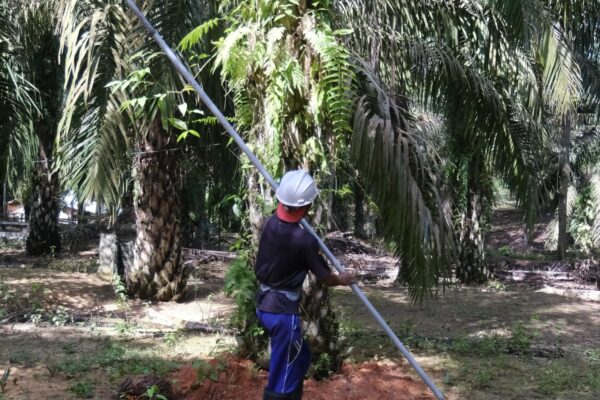
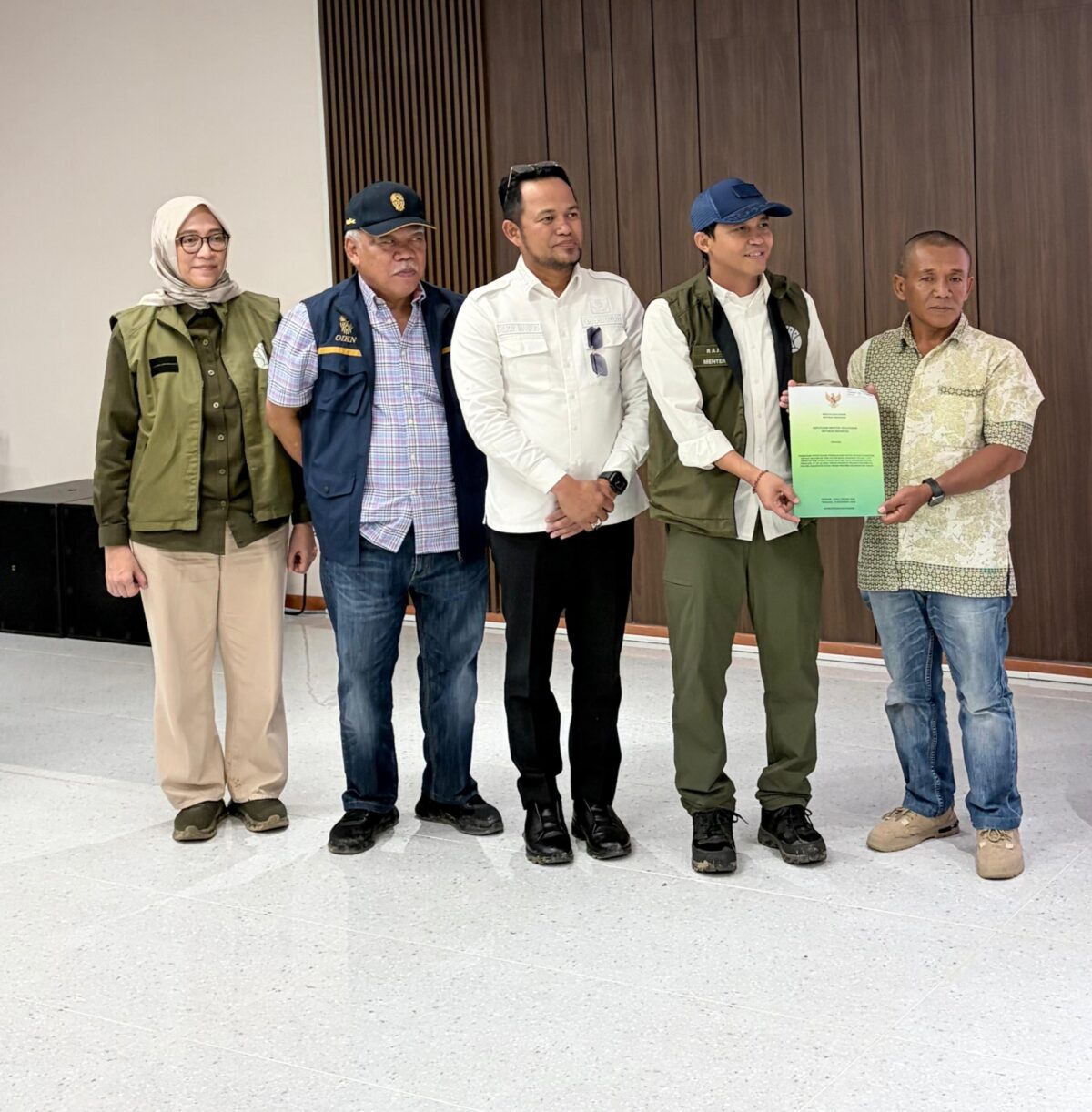
East Kalimantan, 28 February 2026 — Indonesia's Minister of Forestry, Raja Juli Antoni, officially handed over a 127-hectare social forestry management permit to the Wana Makmur Forest Farmer Group (Kelompok Tani Hutan Wana Makmur), a beneficiary community of Apical’s Sustainable Living Village (SLV) Programme, during a ceremonial event held in the National Capital City (IKN), East Kalimantan. This handover marks an important milestone for Apical, which, together with Earthworm Foundation, communities, and partners, is promoting alternative livelihoods through the strengthening of local institutions and the application of agroforestry practices. This initiative is also aligned with and supports the Ministry of Forestry’s target to achieve 1.1 million hectares of social forestry by 2029.
During the ceremonial handover, the Minister of Forestry, Raja Juli Antoni, expressed his appreciation to the communities that had gone through the verification process to obtain forest management permits. He stated that social forestry is one of President Prabowo’s flagship programmes. With the issuance of social forestry permits, farmers are granted access to manage and utilise forest areas. “With this access, communities are given legal certainty to optimise the functions of forest areas in their regions. We hope that forest sustainability can be safeguarded together. We still have the responsibility to provide access to around another 3 million hectares and 1.4 million hectares of customary forests in order to optimise forest functions for our farmers and communities,” the Minister of Forestry said in his remarks.
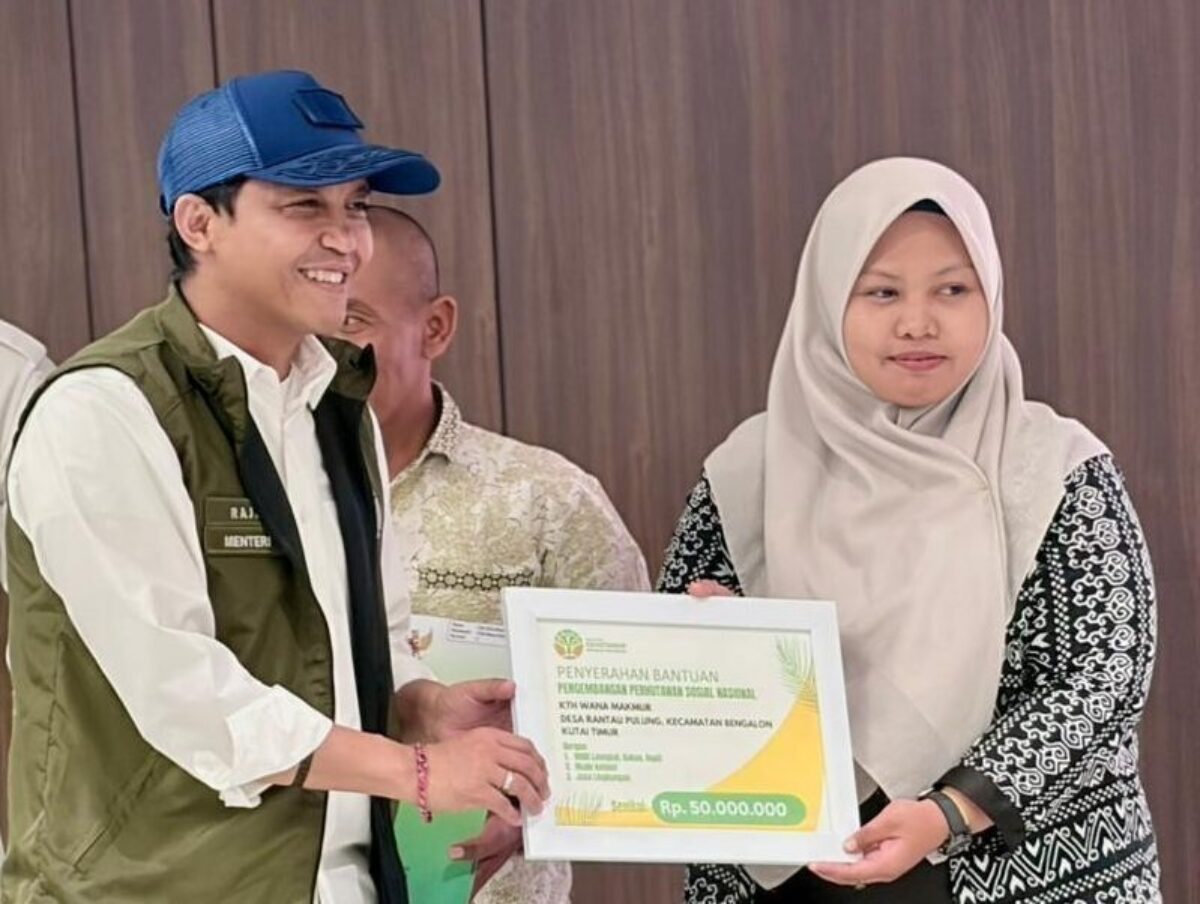
In addition to the handover of the decrees, four Forest Farmer Groups (Kelompok Tani Hutan/KTH), including the Wana Makmur Forest Farmer Group, also received social forestry development assistance amounting to IDR 50 million (USD 2,964). The funds are intended to support the groups’ operational activities and to further develop the businesses already being carried out in their respective areas.
Wana Makmur Forest Farmer Group, which has 32 members, has received support through Apical’s Sustainable Living Village (SLV) Programme, implemented by Earthworm Foundation since 2024. The programme is a multi-stakeholder initiative that aims to promote sustainable livelihoods through collaboration with partners and communities. It seeks to create positive environmental impacts, bridge critical knowledge gaps, and reduce inequalities through four key pillars: improving livelihoods, protecting forests, transforming supply chains, and strengthening stakeholder collaboration.
“We are proud that the SLV programme is able to empower communities, and that the efforts undertaken have received recognition and legal acknowledgement from the Minister of Forestry,” said Agus Wiastono, Corporate Social Responsibility (CSR) Manager at Apical. “Together with our partners, we will continue to support this forest farmer group in developing management plans and managing the social forestry area responsibly, while at the same time strengthening their livelihoods.”
This permit marks an important milestone for the community, signalling the start of agroforestry development. Agroforestry integrates crops such as cocoa under existing forest stands, enabling communities to generate income while maintaining tree cover and preserving ecological functions. With support from Apical, Earthworm Foundation has facilitated the establishment of the Wana Makmur Forest Farmer Group, bringing together members who previously relied mainly on oil palm plantations and faced challenges such as fluctuating market prices and limited access to alternative livelihood options. Since February 2025, the group has been supported with cocoa nurseries and demonstration plots as part of the preparation process during the permit application phase. Cocoa was selected as the main commodity based on its strong production potential and high market demand in the area. The group also plans to diversify its crops by planting other commodities, such as fruit trees, which show strong potential in local markets.
"Beyond income generation, agroforestry contributes to climate resilience. Tree canopy helps retain soil moisture and moderate temperatures, reducing vulnerability to drought and extreme weather. Diverse planting systems also support biodiversity and soil health, strengthening the ecological foundation on which community livelihoods depend", said Bahrun, East Kalimantan Project Manager at Earthworm Foundation. “Now that the group can manage the social forestry areas with agroforestry, they can put into practice what they have learned and in the long run we will also support access to markets. We hope that the community can finally harvest the fruits of their commitment and spirit to manage the land responsibly.”
During the permit handover ceremony, Tugiman, Head of the Wana Makmur Forest Farmer Group (KTH Wana Makmur), expressed his gratitude. “The granting of this permit gives us certainty and encourages us to manage the area properly through agroforestry. We are committed to developing cocoa and other commodities through agroforestry, so that the forest can continue to provide benefits for our families and our community in the long term.”
Looking ahead, Apical and Earthworm Foundation will continue to work closely with KTH Wana Makmur and local stakeholders to support the long-term success of this agroforestry initiative, expand market access, and build resilient community livelihoods. Through sustained partnerships and collective action, the initiative is expected to be scaled to other villages and farmer groups, contributing to stronger rural economies, healthier forest landscapes, and lasting social and environmental benefits for the wider region.
Media Contact:
Corporate Communications, Apical Group | Surel: corpcomms@apicalgroup.com
Sheila Kartika, Manajer Komunikasi Regional Indonesia dan Malaysia, Earthworm Foundation | Surel: s.putri@earthworm.org
About Apical
Apical is a leading vegetable oil processor with an expanding global footprint. Our vertically integrated mid-stream refining and value-added downstream processing make us an integral supplier that supports the needs of various industries, namely food, feed, oleochemicals, and renewable fuel, including sustainable aviation fuel (SAF), which enables a significant reduction of CO₂ emissions.
With integrated assets in strategic locations across Indonesia, China and Spain, Apical operates numerous refineries, oleochemical plants, renewable fuel plants, and kernel crushing facilities. Through joint ventures and strategic partnerships, Apical also has processing and distribution operations in Brazil, India, Pakistan, the Philippines, the Middle East, Africa, the USA, and Vietnam.
Apical’s growth is built on the foundations of sustainability and transparency. We are motivated by our strong belief that we can contribute to a circular economy for meaningful impact as we continue to grow our business and deliver innovative solutions to our customers.
For more information, please visit www.apicalgroup.com.
About Earthworm Foundation
Earthworm Foundation is an impact-driven non-profit that works with businesses, civil society, communities, governments, and other partners to tackle environmental and social issues in sourcing landscapes and supply chains. With expertise in supply chains, social issues, and the environment, Earthworm operates in various regions to improve worker conditions, protect forests, and restore ecosystems affected by palm oil, rubber, cocoa, and other commodities. In Indonesia, Earthworm operates through a national foundation, Yayasan Hutan Tropis. Find out more at www.earthworm.org.