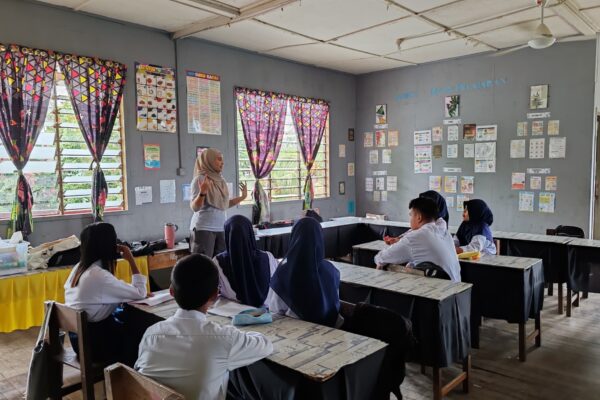
No Deforestation, No Peat and No Exploitation (NDPE) has become a defining expectation in global palm oil markets. What began as a voluntary commitment is now increasingly a baseline for market access, shaping how companies source and manage their supply chains.
Yet implementation on the ground remains uneven. Translating NDPE from policy into practice requires navigating complex realities across producing landscapes. This gap is visible in Aceh, Indonesia, where forests, livelihoods, and palm oil production are closely interconnected.
In many producing areas, traceability weakens beyond the mill level, where sourcing networks become more fragmented and informal. Smallholders, who play a critical role in production, are not always fully integrated into traceability systems or sustainability programmes. This creates blind spots where risks such as deforestation, peatland encroachment, labour issues, and land conflicts can go undetected.
Addressing these challenges requires more than company commitments alone. It requires practical implementation at the landscape level, where local governments, communities, suppliers, and companies work within the same ecosystem and supply chain.
Recognising these realities, Earthworm Foundation and Swisscontact facilitated Aceh NDPE Local Business Forum in February 2026. The forum brought together more than 60 participants from 53 institutions, including government representatives, companies, certification bodies, civil society organisations, and market actors. The discussions focused on how global NDPE commitments can be translated into practical action that works for both people and nature.
Preventing deforestation and protecting peatlands depends not only on policies, but also on how land is managed across entire landscape.
In Aceh, Earthworm Foundation works with companies, suppliers, smallholders, communities, and local governments to help translate NDPE commitments into practical action on the ground. A key focus is strengthening traceability and supporting implementation of High Conservation Value (HCV) and High Carbon Stock (HCS) approaches within supply chains.
This includes support for traceability, identification and monitoring of conservation areas, biodiversity monitoring, riparian restoration, and forest rehabilitation within concessions. Between 2021 and 2025, more than 10,000 hectares inside company concessions were protected through collaboration with eight companies.
The forum also highlighted how suppliers can strengthen implementation when supported with practical guidance and sustained engagement.
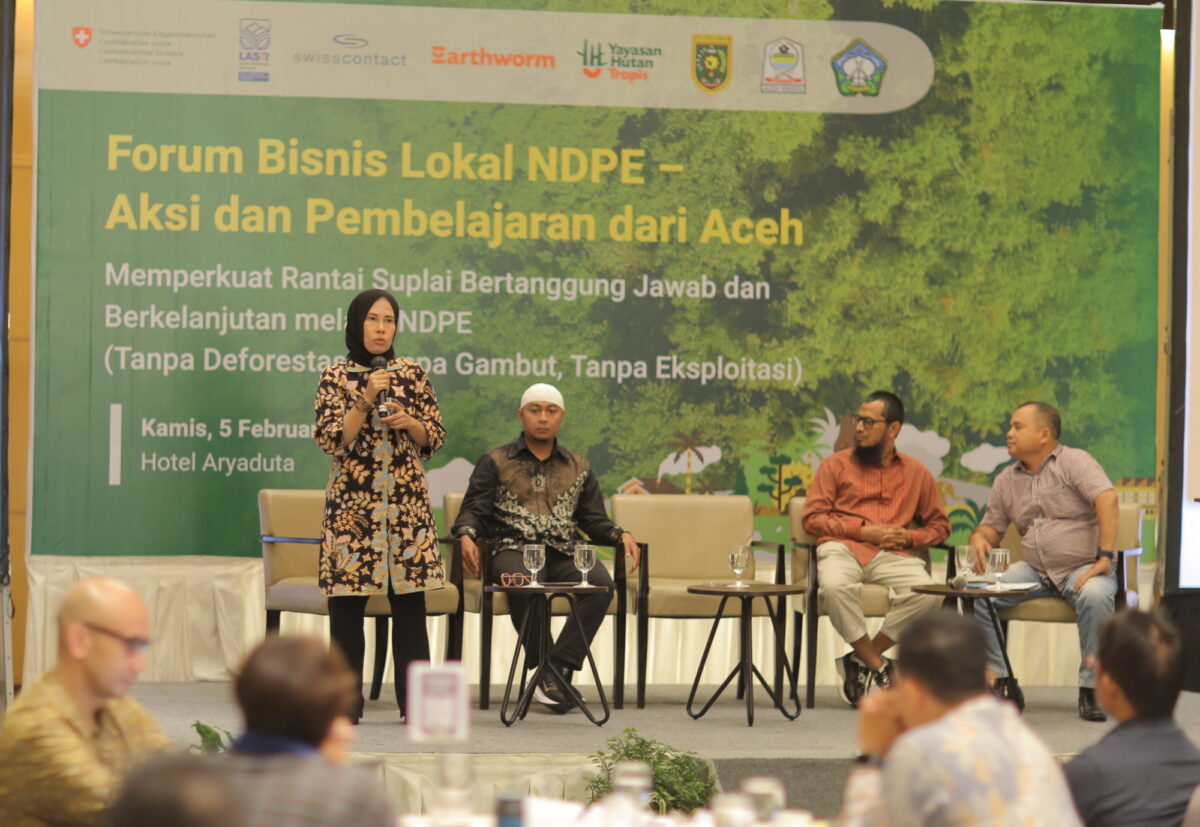
As shared by Sri Marlina Berubarus, Sustainability Coordinator at PT Aceh Trumon Anugerah Kita, “We began with limited understanding of NDPE, but with support from Earthworm Foundation and our buyer, we strengthened our implementation on the ground and have now achieved 100% traceability. This includes improving labour practices, such as preventing child labour and extending NDPE awareness to our suppliers through continuous engagement.”
While supply chain engagement is important, implementation also depends on stronger land governance at the community level. Earthworm also supports stronger land governance at the community level through Participatory Land Use Planning (PLUP) and Participatory Mapping and Land Tenure Studies (PM-LTS). Through these approaches, communities work together to clarify village boundaries, identify conservation areas, strengthen land-use arrangements, and improve tenure security through participatory processes involving local stakeholders.
These approaches help reduce land conflicts, improve clarity over land use, and strengthen long-term community ownership over natural resources — recognising that preventing deforestation is not only about monitoring forests, but also about supporting practical governance systems that work for both communities and conservation.
Some of the most challenging NDPE risks to identify are also the least visible. While deforestation can increasingly be monitored through satellite systems and traceability tools, labour and exploitation risks often remain embedded deeper within fragmented sourcing networks.
In complex supply chains, particularly those involving smallholders and intermediaries, oversight of working conditions becomes more challenging.
Aryo Gustomo, Roundtable on Sustainable Palm Oil Assurance Director shared, “Challenges related to exploitation have become a key area of attention over the past two to three years. Workforce issues, such as wages and forced labour, are becoming a major focus, especially in European markets.”
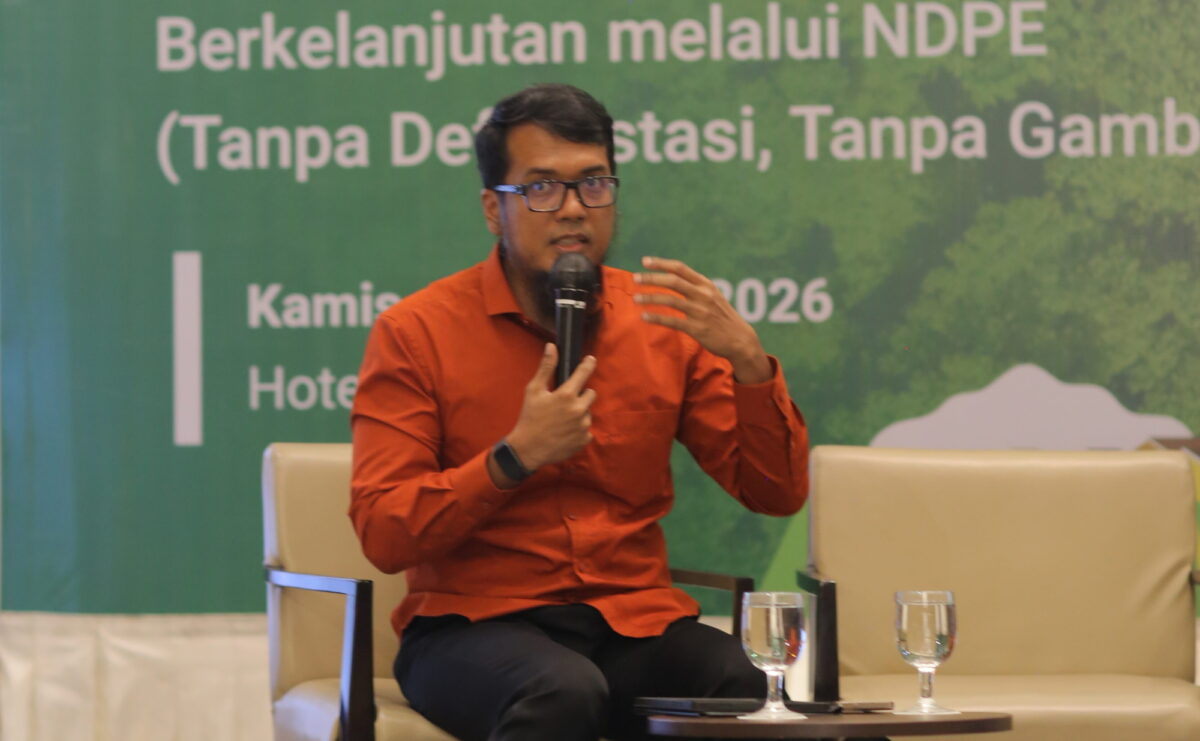
Effective NDPE implementation must go beyond environmental safeguards. It must also strengthen systems that protect workers, improve transparency, and ensure that responsible practices extend throughout the supply chain.
Since 2021, Earthworm Foundation has supported improvements in working conditions for 2,315 workers across seven companies. This included support on occupational health and safety, provision of personal protective equipment (PPE), health checks, social security access, wage and working hour policies, and measures to reduce women’s and child labour risks.
Beyond technical support, Earthworm also works with companies and labour working groups to strengthen understanding that fair labour practices are a core part of NDPE commitments. Several companies showed progress toward more proactive labour practices, including functioning bipartite forums, improved occupational safety measures, and stronger respect for freedom of association. While gaps remain in areas such as employment formalisation and consistent implementation, these experiences demonstrate that labour improvements require continuous engagement and long-term follow-up.
Discussions during the forum highlighted that many NDPE challenges cannot be addressed by individual actors alone, particularly where supply chains remain fragmented and visibility beyond the mill level is limited. Strengthening NDPE implementation begins with better visibility into sourcing relationships across the supply chain.
Nofri Iswandi, Supply Chain and Transformation Manager at Earthworm Foundation in Indonesia mentioned, “NDPE starts with supply chain mapping and traceability to the plantation. Collaboration between smallholders, dealers and brands is essential to strengthen implementation.”
Across Aceh landscape, NDPE implementation is increasingly taking shape through collaboration between companies, communities, suppliers, and local governments. Efforts range from strengthening traceability and HCV-HCS implementation within supply chains, to participatory land-use planning, community-led forest monitoring, and stronger alignment between local governance and sustainability commitments.
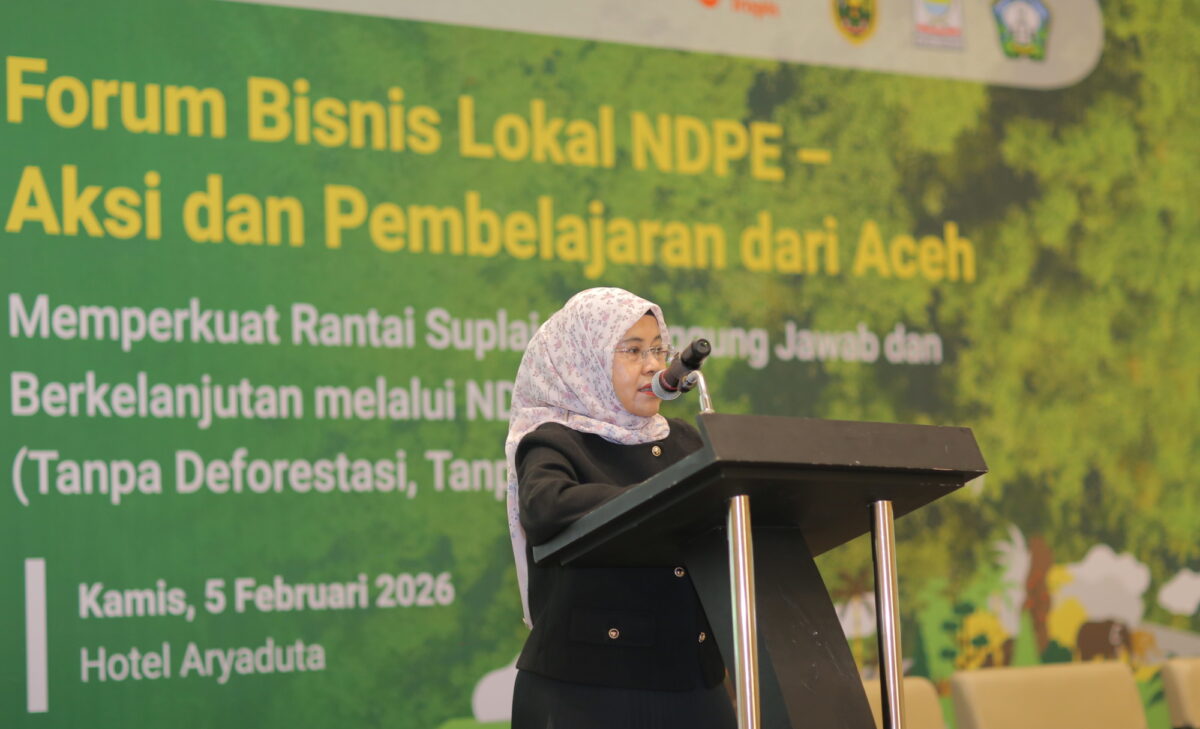
Cut Huzaimah, Head of Aceh Agriculture and Plantation Office emphasised, “This forum is a strategic space to strengthen understanding, implementation and commitment to NDPE, so Aceh’s palm oil can be accepted by global markets. NDPE must reach not only companies, but also smallholders.” These efforts illustrate that implementation is not a single action, but an ongoing process that requires coordination, trust, and long-term commitment.
Expanding NDPE implementation across the supply chain, particularly among smallholders, requires stronger alignment between market expectations, policy frameworks, and realities on the ground.
Discussions during Aceh NDPE Local Business Forum highlighted several priorities moving forward. Stakeholders emphasised the importance of strengthening coordination through the reactivation of the Natural Resources Management Working Group, alongside clearer workplans and roles across stakeholders.
Participants also highlighted the need for stronger commitments to prevent oil palm expansion into forest areas, while continuing to improve Traceability to Plantation (TTP) systems among suppliers in line with NDPE commitments and market expectations.
At the same time, discussions reinforced that implementation cannot rely on policies alone. Continuous engagement and awareness raising among farmers, communities, and supply chain actors remain essential to ensure that sustainability commitments are understood and implemented effectively.
Land conflicts and unclear land boundaries were also identified as persistent challenges affecting implementation. Experiences in Aceh show that strengthening land governance, participatory mapping, and collaborative conflict resolution processes remain critical to reducing risks and improving long-term accountability.
Across Aceh landscape, ongoing efforts show that strengthening responsible palm oil requires more than commitments alone. Long-term progress depends on collaboration between companies, governments, communities, and supply chain actors working together to translate NDPE commitments into practical implementation on the ground.
Aceh NDPE Local Business forum was made possible with the support of SECO Economic Cooperation and Development's Sustainable Landscape Program Indonesia (SLPI) through Leuser–Alas–Singkil River Basin (LASR) Programme, implemented by Earthworm Foundation and Swisscontact, and supports the implementation of Aceh’s Regional Action Plan for Sustainable Palm Oil.
This initiative is also part of a broader collective action in Earthworm’s Aceh landscape, financially supported by Hershey, Mars, Nestlé, ADM Cares, Avril Group, Colgate-Palmolive, The Clorox Company, General Mills, Givaudan, and Fuji Oil, and strengthened through the engagement of communities, local government and other local stakeholders.