Share


Share
To help stakeholders access information that is reliable and science-based, we created five concise, downloadable fact sheets, each one focusing on an alternative to fishmeal or fish oil, presenting its advantages, limitations, and sustainability considerations. The choice of ingredients reflects the priority alternatives being considered in the context of the Aquafeed Initiative, coordinated by Earthworm Foundation, which aims to support companies and producers in sustainably reducing their dependence on marine natural resources.
These fact sheets are part of the work carried out under the Aquafeed Initiative. Learn more about the Aquafeed Initiative.
To access the full sheets, click on the boxes below.
Modern aquaculture plays a key role in global food security and continues to grow rapidly in response to rising demand for aquatic proteins. Salmon farming, along with other carnivorous species, still relies heavily on fishmeal and fish oil produced from wild pelagic fish. These ingredients are valued for their high levels of essential amino acids and long-chain omega-3 fatty acids (EPA and DHA) (see Table 1). However, marine resources are limited by the natural productivity of ecosystems, and global catch levels have remained relatively stable over the past decades (Hua et al., 2019).
Industrial reduction fisheries are also associated with concerns such as risks of forced labor aboard fishing vessels and increased competition with small-scale fisheries, potentially affecting the livelihoods of vulnerable coastal communities in regions like India and West Africa.
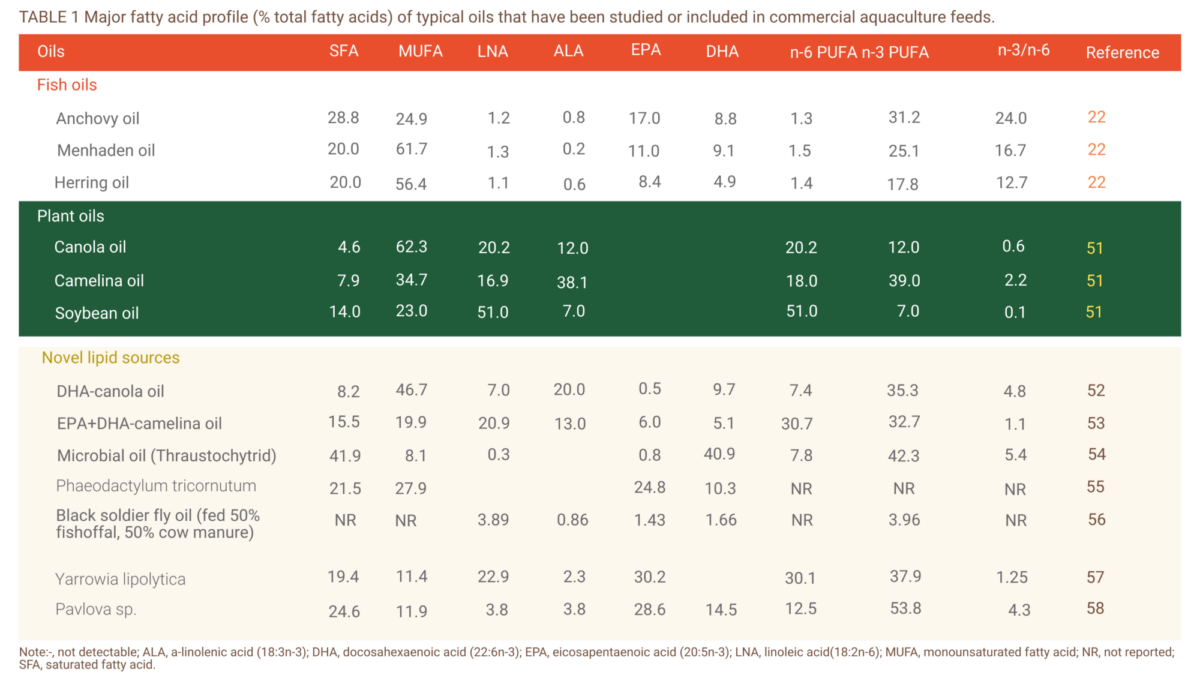
EPA (Eicosapentaenoic Acid) and DHA (Docosahexaenoic Acid), also known as marine omega-3s, are critical for both fish health and human nutrition. In salmon, they support normal growth, stress resilience, tissue integrity, and the nutritional quality of the fillet. For humans, regular intake of EPA and DHA contributes to cardiovascular health, neurological development, and inflammation regulation (Bou et al., 2017; Santigosa et al., 2023; Zhang et al., 2024).
Growing pressure on wild fish stocks, combined with rising global fish consumption and market volatility, has driven aquaculture toward greater use of plant-based proteins and oils. This shift has helped reduce reliance on marine ingredients. However, plant oils do not contain EPA or DHA (see Tableau 1), which makes it difficult to fully replace fish oil with this source. As a result, farmed salmon today contains lower levels of EPA and DHA compared to previous decades, but fish oil remains necessary in feed formulations, even though an increasing share now also comes from fisheries by-products.
Protein quality and amino acid balance are also essential for salmon nutrition, and fishmeal remains the gold standard. While soy is today the main protein source in feeds, its amino acid profile is less optimal for fish. Animal-derived alternatives, namely by-products from land-based animal farming, offer amino acid profiles closer to fishmeal and in some cases a lower carbon footprint, but their adoption still faces several barriers (Glencross et al., 2023).
To address these challenges, research and innovation now focus on developing new feed ingredients and integrating existing alternatives that can meet fish nutritional requirements, ensure consumer safety and health, reduce environmental impact, and ensure economic viability (Nagappan et al., 2021).
Bou, M., Berge, G. M., Baeverfjord, G., Sigholt, T., Østbye, T.-K., & Ruyter, B. (2017). Low levels of very-long-chainn-3 PUFA in Atlantic salmon (Salmo salar) diet reduce fish robustness under challenging conditions in sea cages. Journal of Nutritional Science, 6. https://doi.org/10.1017/jns.2017.28
Glencross, B., Fracalossi, D. M., Hua, K., Izquierdo, M., Ma, K., Øverland, M., Robb, D., Roubach, R., Schrama, J., Small, B., Tacon, A., Valente, L. M. P., Viana, M., Xie, S., & Yakupityage, A. (2023). Harvesting the benefits of nutritional research to address global challenges in the 21st century. Journal of the World Aquaculture Society, jwas.12948. https://doi.org/10.1111/jwas.12948
Hua, K., Cobcroft, J. M., Cole, A., Condon, K., Jerry, D. R., Mangott, A., Praeger, C., Vucko, M. J., Zeng, C., Zenger, K., & Strugnell, J. M. (2019). The Future of Aquatic Protein: Implications for Protein Sources in Aquaculture Diets. One Earth, 1(3), 316–329. https://doi.org/10.1016/j.oneear.2019.10.018
Nagappan, S., Das, P., AbdulQuadir, M., Thaher, M., Khan, S., Mahata, C., Al-Jabri, H., Vatland, A. K., & Kumar, G. (2021). Potential of microalgae as a sustainable feed ingredient for aquaculture. Journal of Biotechnology, 341, 1–20. https://doi.org/10.1016/j.jbiotec.2021.09.003
Santigosa, E., Olsen, R. E., Madaro, A., Trichet, V. V., & Carr, I. (2023). Algal oil gives control of long‐chain omega‐3 levels in full‐cycle production of Atlantic salmon, without detriment to zootechnical performance and sensory characteristics. Journal of the World Aquaculture Society, 54(4), 861–881. https://doi.org/10.1111/jwas.12947
Zhang, Z., Miar, Y., Huyben, D., & Colombo, S. M. (2024). Omega‐3 long‐chain polyunsaturated fatty acids in Atlantic salmon: Functions, requirements, sources, de novo biosynthesis and selective breeding strategies. Reviews in Aquaculture, 16, 1030–1041. https://doi.org/10.1111/raq.12882
Contacts:
